
Financial wellness and mindful eating are two different things. But they have something in common. Our relationship with our bodies and our money is connected. Both are driven by the same triggers, emotional habits, and some patterns. To understand these two, we must first know what is the meaning of financial wellness and its similarity to mindful eating are.
What is the Meaning of Financial Wellness?
To understand why mindful eating and financial wellness are closely aligned, you have to look at how you behave when you’re not being mindful. When was the last time you scrolled through Facebook Marketplace at night, for instance, adding items to your cart because you’re bored or stressed? Then, you wondered a week later why you bought them in the first place.
That is also the same as sitting in front of the TV with a pint of ice cream or a bag of chips. Then, after consuming it all, you have not tasted a single bite, even though you’ve eaten the entire pint or bag.
These are examples of operating on autopilot. This is your mind state where your impulses dictate your actions without using your conscious mind. It’s the reason your awareness is the foundation of financial wellness and physical health. Without awareness, you can’t change your direction because you can’t see the habits that drive your choices.
To achieve sustainable health or financial peace, you don’t wish to start with a restrictive diet or a tight budget. Rather, you must start with awareness without judgment. However, to cultivate financial awareness through self-awareness , you need to look at your spending habits. But be honest about it. You must also identify your emotional triggers and understand your money mindset.
This is similar to nutrition. You must notice first when you eat out, whether it’s physical hunger or out of loneliness or anxiety.
In both of these areas, awareness is the best tool that must be taken into consideration first.
Regulate Emotions to Overcome Impulse

Money and food are common drivers you use to cope with your anxiety, right? Consumption and eating are your instant stress-relievers. You shop for shoes when you’re stressed or order food to relieve your anxiety. For many of us, retail therapy is a cure for our bad days, and comfort foods are rewards for allowing us to survive a difficult week.
The patterns for impulse buying and emotional eating are the following:
- The Trigger: This can be stress, boredom, sadness, or insecurity (mine is usually stress). These are negative emotions that you feel from time to time.
- The Action: You reach for a dopamine hit through purchasing a new iPhone or shoes online, or grabbing a bag of Doritos from the pantry. Mine is usually a slice of cheesecake.
- The Hangover: The temporary high fades as quickly as the last bite reaches your throat. Unfortunately, you’ll feel guilty after eating everything. You’ll regret it because you know that there are consequences.
Mindful eating, on the other hand, teaches you to create a gap between your urge to eat and your response to the act of eating. When you master it, you tend to pause, breathe, and ask yourself: “Am I physically hungry or am I just soothing an emotion?”
This is similar to being aware of your finances. You pause before you hit that checkout button because you know you can’t afford it. When you apply this strategy to your finances, you can learn to pause before you make a purchase and ask: “Am I buying it because it adds joy to my life or just fills a void?”
You must master this pause to help you transition from being a reactive person to an intentional buyer.
Mindful Consumption: What is It?
Mindful eating and financial wellness have the same philosophy. That is mindful consumption. It’s important to note that consumption isn’t bad. Keep in mind that you need to eat to survive. You also need to spend money to enjoy your life. I spend most of my money on golf these days, but this sport is giving me joy. The problem arises when you consume food or things excessively. An issue also arises when your consumption disconnects you from your needs and values.
Mindful consumption helps you shift your focus from quantity to quality. When it comes to mindful eating, you choose nutrient-dense foods that offer proper nourishment, instead of eating processed foods. In your finances, it means you invest your money in high-quality experiences (golfing or traveling, for instance) that support your long-term goals, instead of wasting your money on low-value trends.
When you practice mindful consumption, you start to reduce your waste. You waste less food because you only buy what you intend to eat. You also waste less money because you only buy what you truly value. This shared philosophy creates abundance rooted in appreciation or gratefulness, instead of an artificial sense of abundance.
The Effects: One Decision at a Time
Many of us believe that physical fitness and wealth accumulation require massive overhauls so you can be successful. You assume that you need millions of dollars or a restrictive lifestyle just to see results.
The reality, however, is that you just need a quiet accumulation of your daily choices.
Consider the effect of your habits. You can save a small amount of your money every month. You might think that it won’t matter in the short term. However, over a decade, compound interest turns your contributions into a financial safety net.
This is similar to choosing a home-cooked meal over McDonald’s Twister fries once or twice a week might not transform your body overnight. But over the weeks or months, it shifts your health and longevity.
You’re building financial wellness one mindful decision at a time. Each time you check your accounts before you make a purchase, and opt to wait 24 hours before you hit the checkout button, you’re voting for your future self. This same rule can be applied to your health. Every conscious meal is an investment in your vitality.
How Eating Mindfully Can Help You Save Money?
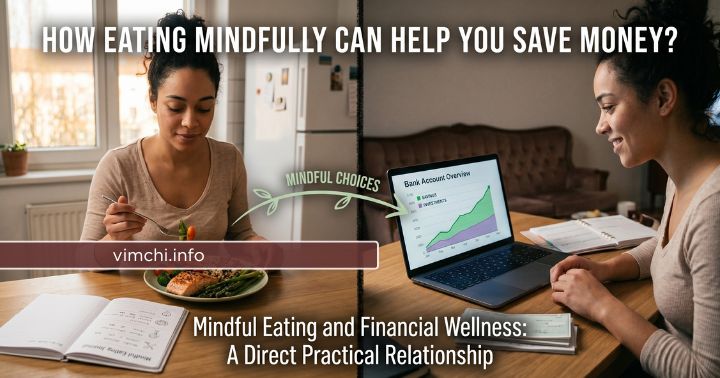
It’s true that there are similarities between mindful eating and financial wellness in terms of philosophy. There’s a direct practical relationship between the two. You must understand that the role of mindful eating to help you achieve your financial wellness can transform your bank account.
You remember the financial ruin that might occur when your spending habits are not organized, or they’re driven by convenience.
Cost of Convenience
You rely on food delivery apps or pre-packed meals. There’s nothing wrong with it. But if you do it frequently, the service fees and delivery charges quickly add up. This can reduce your monthly budget.
Food Waste
When you buy groceries without a plan or cook based on your whims frequently, this can lead to some ingredients rotting in your drawer. Unfortunately, this can result in you throwing money into the trash.
Health Costs
If you mindlessly consume highly processed foods frequently, it can lead to chronic health issues. This results in higher medical bills or insurance premiums down the road.
When you start using a structured tool like our mindful eating journal, you can start planning your meals with intention. This act of tracking and slowing down will help you be more intentional about your grocery shopping. It means that you only buy what your body needs or cook more mindfully at home. You reduce your reliance on impulse takeout and eliminate food waste.
Your wallet will thank you for it as you heal your relationship with food. This is a tangible positive effect of mindful eating. The money you can save from avoiding mindfulness food spending can go directly to your emergency fund or debt repayment.
Wellness as a Form of Self-Care
Many of us think that budgets and diets are a form of punishment or deprivation. You’ve been conditioned to view a budget as a prison that stops you from having fun. Diet, for instance, is a prison that keeps you away from the comfort foods that you love.
But when you start being mindful, this toxic mindset will be framed as an act of self-care. Viewing your financial stability and physical health as punishments can lead to burnout. When you reframe them as self-care, you change your motivation. Instead of fearing budget or diet, you think of it as self-love.
Embracing financial wellness as a form of self-care will help you view saving money as a way to live intentionally. It’s no longer about depriving yourself in the present. You see it as protecting your peace. It’s knowing that you can handle an unexpected medical bill. You won’t stay in the job that you hate because you need the next paycheck. You’re building a life of freedom. True freedom, that is.
Mindful eating is also self-care. You refuse to treat your body like a trash can. It’s the practice of intentionally eating to honor your hunger. You start to appreciate the fuel that the food offers.
The Path Forward
Money and food reflect how you treat yourself and how you navigate the world. If you’re avoidant with your money, you’re often running those patterns in your pantry. If you’re restrictive with your food, those anxieties spill over into your financial decisions.
When you start to cultivate deep presence in one area of your life, it bleeds into another area. Understanding what is the meaning of financial wellness means that you learn to slow down and observe the partners. You realize that the discipline required to build your wealth is the same discipline needed to cultivate physical health.
If you wish to start mindful spending to build your financial wellness, you may download our mindful eating journal here.
What is the Meaning of Financial Wellness: Frequently Asked Questions?
What is an example of financial wellness?
Financial wellness is about having security and choice. An example is having a dedicated emergency fund that can cover 3 to 6 months of living expenses. If your car breaks down, don’t panic. You pay the bill calmly because you’ve intentionally prepared for this type of bump in your life.
What is another word for financial wellness?
Financial wellness is often referred to as financial peace of mind or financial vitality. You can also say it’s financial freedom.
What are the benefits of financial wellness?
When your finances are healthy, the benefits arise from every area of your life. It can drastically lower your stress. Make your relationships stronger.
How to make financial wellness your reality?
Financial wellness is built through daily habits that are rooted in self-awareness. You can make it your reality by practicing mindful consumption. Look at your bank account to know where your money goes. Awareness is always the foundation.
What is the purpose of financial wellness?
The true purpose of financial wellness is to take money out of the driver’s seat of your life. In that way, you can easily steer. Money must be a tool to support your existence, but it must not be a source of fear that controls your decisions.

Jane is a licensed medical technologist who bridges the gap between clinical precision and digital innovation. While her formal background is rooted in the meticulous world of laboratory science, her passion lies in the logic of software development. When she isn’t analyzing data or writing clean, efficient code, you can find her on the golf course, applying that same focus and discipline to her swing.
I’m so glad you’re here. Your perspective adds so much value to this community—feel free to leave a note below!