
Mindful eating is the practice of paying attention to your food, physical hunger, fullness, emotions, and eating experience without judgment. It’s not about following strict food rules. Instead, it’s about slowing down and noticing why you’re eating, how the food tastes, and how your body feels before, during, and after a meal. You can easily start by using our mindful eating starter kit here.
It’s the total opposite of mindless eating. That is, you’ve finished your meal while you scroll through your phone and barely remembered eating it.
In this guide, you’ll learn all the principles of mindful eating, how to recognize hunger and fullness cues, simple exercises for beginners, and practical ways to build a more intentional relationship with your food. This guide will retrain your brain to shift from emotional consumption to intentional eating.
Table of Contents
- Mindful Eating
- What are the Benefits of Mindful Eating
- 7 Core Principles of a Mindful Meal
- Mindful Eating vs. Mindless Eating
- Understanding Hunger and Fullness Cues
- Emotional Hunger vs Physical Hunger
- How Mindful Eating Can Help with Emotional Eating
- How to Practice Mindful Eating
- 5 Mindful Eating Exercises for Beginners
- Common Mindful Eating Mistakes
- Use a Mindful Eating Journal to Practice
- Frequently Asked Questions
What Mindful Eating Is?

Download The OMAD and Mindful Eating Journal: Stop the Binge-Restrict Cycle (PDF)
Mindful eating is a branch of mindfulness, which is a widespread practice used in many religions. Mindfulness, per se, is an intentional focus on your thoughts, emotions, and physical sensations in the present. When you practice it religiously, you’re becoming more aware of your situation and choices, instead of reacting to them.
Eating mindfully is about using your senses to experience and enjoy the food choices you make. When you practice it a lot, you become more grateful for your food, which can greatly improve your overall eating experience. It’s true that mindful eating encourages you to make choices that satisfy and nourish your body. But it doesn’t judge your eating behaviors. As you become aware of your eating habits, you take steps towards behavior changes that will benefit you.
Thus, you don’t have to ask, “Am I allowed to eat this?” Instead, you’d ask yourself these questions:
“Am I hungry?”
“What am I feeling right now?”
“What would feel satisfying?”
“How does my body feel as I eat?”
What Mindful Eating Benefits Include?

The benefits of mindful eating are aplenty. These would include the following:
- Improved digestion: Mindful eating encourages slowing down and fully chewing your food. This aids in the digestive process. It also reduces the chances of you getting gastrointestinal discomfort, like indigestion and bloating.
- Weight management: Mindful eating is also linked to healthier weight management results. It helps you lose weight or maintain your current weight. You’re less likely to overeat or engage in emotional eating because you’re more aware of your hunger and fullness cues.
- Enhanced satisfaction: You savor every bite and pay attention to your senses. It helps you feel more satisfied and fulfilled by your meals. This leads to reduced cravings and a sense of contentment.
- Stress reduction: Eating mindfully is a form of meditation. It reduces your stress levels and promotes relaxation. When you focus on the present moment, you can create a more peaceful eating experience.
For a deeper look at how mindful eating can help you, read our 11 benefits of mindful eating backed by research.
7 Mindful Eating Core Principles
These core principles of mindful eating can assist you in moving to intentional eating. They help transform the act of eating into an act of self-care:
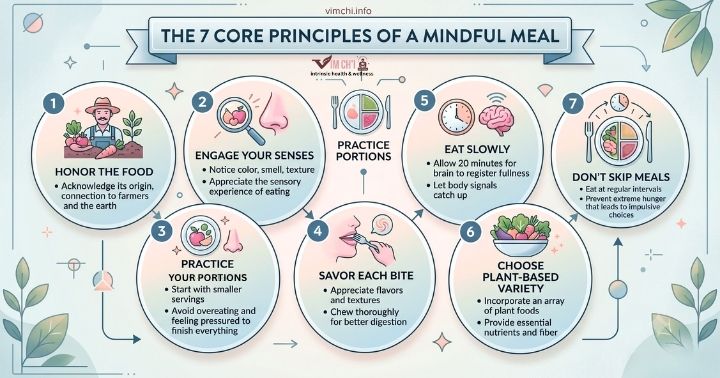
1. Sit Down and Eat
Eating can feel like one of the times on your to-do list. You rush through your day, eating whenever you get a chance. You make time to sit and eat. But you stare mindlessly at the TV without paying attention to what you’re eating. You contemplate how you eat faster so you can move to the next task.
With mindful eating, you need to sit down and unplug. Avoid watching V. Don’t talk on the phone or text while you eat. Step away from your computer and stop working.
Doing so will help you enjoy and savor your food. You can focus on your meal.
2. Eat Slowly
It takes 20 minutes or so for your brain to receive the signals from your gut that you’re full. By eating slowly, you’re giving your body time to catch up. When you pause in between bites, you’re facilitating a healthy habit of eating slowly.
To eat slowly, just set your fork down in between bites. Pause. Finish first what’s in your mouth before you take another bite. You may engage in conversation if you eat with your family or friends. Your aim here is to get full and be satisfied.
By eating slowly, you can prevent overeating that causes weight gain and digestive stress.
3. Savor Each Bite
Eating on the run without chewing very well can easily result in undigested food particles floating through your colon. Unfortunately, these particles can trigger unpleasant symptoms, such as bloating, gas, and indigestion.
Chew your food thoroughly. You can only swallow it when your food has already a fine texture. Experts do suggest chewing each bite 30 times. The longer food is exposed to saliva through chewing, the easier it moves through your intestines.
4. Avoid Gulping
Your digestive system does require hydration to process your food more efficiently. But if you drink lots of water during meals, the water only dilutes your stomach acid, thereby slowing down your digestion.
That’s why it’s pertinent to drink water 15 minutes before mealtime. And drink again 30 minutes after a meal. If you do need to drink water with a meal, just take small sips. Don’t gulp.
By drinking a small amount of water during a meal, you can avoid or reduce gas and bloating.
5. Embrace Your Senses
Mindful eating can be a stimulating experience. You can observe your meal’s colors, textures, and aromas. You can even notice how you sound when you eat your food. It’s important to remember that eating is not just about tasting your food. Rather, it’s also about tapping in all your senses to be fully present while eating.
At your next meal, notice your food’s colors and shapes. Close your eyes and smell its aroma. Keep your eyes closed and notice the noises that you hear. While taking a bite, notice the flavors and textures as you chew.
6. Eat When Hungry
This can be difficult. But eating only when you’re hungry helps you not feel satisfied. You’ll feel guilty later about overeating.
Eating only when you’re hungry reminds you that your body needs energy. This helps you avoid emotional eating and mindless snacking that prevent those guilty feelings as you move into mealtime. It also helps you avoid excessive weight gain.
7. Honor Your Food
Honor your food by acknowledging the time and effort some people put into creating your meal. Take a moment to consider the ingredients used and how they are prepared. Say a blessing or pause just to acknowledge your good fortune before the meal.
A New Direction for Us, Vim Ch’i
If you’ve followed us for a while, you know that we focused on Herbalife shakes and traditional dieting. But our medical background led us to a powerful realization. That is, meal replacement is not true wellness. Rather, true wellness is built through sustainable habits and awareness. Read more about our transition to help you master the art of journaling and somatic eating on our About Us page.
Mindful Eating vs Mindless Eating

Mindful eating and mindless eating are not about your good and bad behavior. They are just your levels of awareness.
| Mindless Eating | Mindful Eating |
|---|---|
| Eating while distracted | Paying attention to the meal |
| Eating automatically | Pausing before eating |
| Ignoring early hunger | Noticing hunger cues |
| Eating very quickly | Slowing down |
| Focusing only on finishing the plate | Checking satisfaction as you eat |
| Reacting automatically to cravings | Exploring what may be triggering the craving |
| Judging yourself afterward | Reflecting with curiosity |
It’s important to remember that you can never eat all the time mindfully. But always remind yourself that the objective here is to practice becoming more present. Doing so will help you avoid turning mindful eating into another form of dieting.
Understanding Hunger and Fullness Cues
Hunger and fullness cues are something that you experience each day. They serve as a way for you to evaluate whether or not you need to eat or stop eating. Infants, for instance, are great at determining their hunger and fullness cues. When the infant is hungry, he/she cries to inform everyone that it’s time to feed him/her. When the infant is full, he/she starts to turn his/her head. The infant also rejects any additional bites you feed him/her.
Unfortunately, as you age, you lose those skills of understanding and recognizing your hunger and fullness cues. The reason is that you lose the connection between your hunger and fullness cues because of various factors. It can be that you have a busy schedule or that you’re tempted by a food ad on social media.
When you’re really hungry, you notice that your energy is reduced. You also have difficulty concentrating. There’s also a gradual desire to eat.
Fullness can appear gradually. You may notice that your hunger disappears or the food becomes less compelling.
For a more detailed exercise, read our hunger-satiety scale guide.
Physical Hunger vs Emotional Hunger
Physical hunger and emotional hunger are two different things. You might have the desire to eat. But it doesn’t mean that you’re physically hungry. Food can be more appealing when you’re bored, stressed, tired, or lonely.
As you practice mindful eating, you don’t eat right away. Instead, you suppress it first. You pause and ask so you can better understand what you’re experiencing right now. Is it physical hunger or emotional hunger?
Physical hunger develops along with bodily sensations and can increase gradually. Emotional eating, on the other hand, may be connected to your emotions or environment.
Read our complete guide to emotional vs physical hunger to further explore their differences.
How Mindful Eating Can Help with Emotional Eating?

Mindful eating can help with emotional eating because practicing eating mindfully can make you more aware of your emotional triggers, like stress or boredom. You’re less likely to snack or overeat when you’re not hungry.
With mindful eating, you spend a moment noticing how hungry you truly are and how you feel emotionally. This brings you back to the present and sets a mindful tone for your meal.
To better understand your feelings, read our practical guide to emotional eating.
How Mindful Eating Can Be Practiced?
To practice mindful eating, you don’t need to transform your routine overnight. You can start with one meal today.
Before you eat, pause first and notice your hunger. Bring your attention to the food during your meal. Then, check your hunger halfway through. This will help you check your satisfaction level.
After eating, notice how you feel. Are you satisfied or not?
The routine can look like this: Pause > Notice > Eat > Check in > Reflect
When you practice it every day, it makes it easier for you to recognize your eating patterns.
5 Mindful Eating Exercises for Beginners
These 5 mindful eating exercises for beginners can help you jumpstart this practice.
1. The Single Bite Meditation
The single bite meditation is the most well-known mindful eating practice. You can try using a single raisin, a nut, or a berry. The food is not as important as the quality of your attention you bring to it.
Hold the raisin or any food in your palm. Look at it for a moment. Notice its shape, texture, color. Be curious about it.
Now, bring it to your nose and breathe its aroma. Notice how it smells. Is it sweet? Earthy?
Place it on your tongue. Don’t chew it yet. Notice how it its weight, texture, or its flavor.
Start chewing slowly. Notice the texture shifts and how the flavor develops. How the experience evolves with each bite.
When you’re ready to swallow, do it deliberately.
Remember that it’s okay for your mind to wander during this exercise. When your mind does wander, simply return to the food and your senses. Don’t judge yourself.
2. The Five Senses Practice
The five senses practice expands your attention across your entire meal. You invite each of your five senses into the experience.
You can try it out by pausing and seeing your food before your first bite. For instance, if you’re eating nuts, look at the colors. Their shapes. The way the light falls across the plate. Let your eyes move slowly. Don’t rush toward tasting the nuts.
Bring your food closer and smell it. Take a slow breath. What is the aroma? Is it warm? Sweet? Herbal? Does it stir a memory? Perhaps it reminds you of the night in the Bahamas.
As you start eating, listen. Listen to the crunch of your food. The softness that gives of something tender. The sound can be grounding when you listen to it.
You should also notice how the food feels in your mouth when you chew. Notice the texture. Is it chewy? Creamy?
Then, notice the taste. Try to identify its flavors. How does it shift with each bite? Notice what arrives first and what lingers.
3. The Hunger and Fullness Check-In
The hunger and fullness check-in is the most transformative practice in mindful eating. It’s dramatic, but it also asks you to listen to your own body.
Normally, when you eat, you eat according to your external signals. It’s not because of your internal cues. For instance, you eat because it’s noon or that the food is already on the table. The hunger and fullness check-in, on the other hand, is an invitation to your body’s wisdom that has been there all along.
You can start by pausing and asking yourself first, “Am I hungry?” Place yourself on a scale from one to ten. One is not hungry at all, and ten is ravenous. Be honest.
When you’re near the middle of your meal, check in with yourself again. How does your body feel now? Are you still hungry, or are you already satisfied? This midpoint pause is the most useful one because it creates a space for you to decide whether to continue eating or stop.
This practice helps you recalibrate your relationship between your appetite and food. You don’t need to get it right immediately. The goal here is to start a conversation with yourself again.
4. A Meal Without Distractions
A meal without distractions is probably the most uncomfortable mindful eating exercise. The reason for this is that you’re used to eating while scrolling or working. It has become a norm for most of us. But in this exercise, you need to have a distraction-free environment. The quiet meal can feel too quiet. But this discomfort can pass quickly.
But it lets you taste your food. And its taste will be different when you have your full attention. The meal slows down. You also notice when you’re satisfied in a way that doesn’t often happen when your half attention is on TV or elsewhere.
To help you start practicing a meal without distractions, try to commit to eating your meal without screens. Don’t read anything. Find a comfortable space to sit. Before you start, try to take slow breaths and allow your busyness to settle.
Then, start eating slowly. Put your utensils down between bites. When your attention wanders toward your tasks, notice it and return to your food and the moment. The noticing and returning is the whole practice.
5. Gratitude Before Eating
Gratitude before eating is the simplest mindful eating practice. You just need to pause for a moment before you start eating. It slows the transition into eating. It also creates a small meaningful space between the meal and whatever came before.
This practice doesn’t need a specific form or phrasing. It can be brief, or it can be a few words spoken aloud.
If you wish to try it out, just pause before your first bite. Close your eyes and let your gaze rest softly on the food. Take a breath and find something to be grateful for. Like, “I’m grateful that my food is warm.” Then, start eating.
Download this checklist: 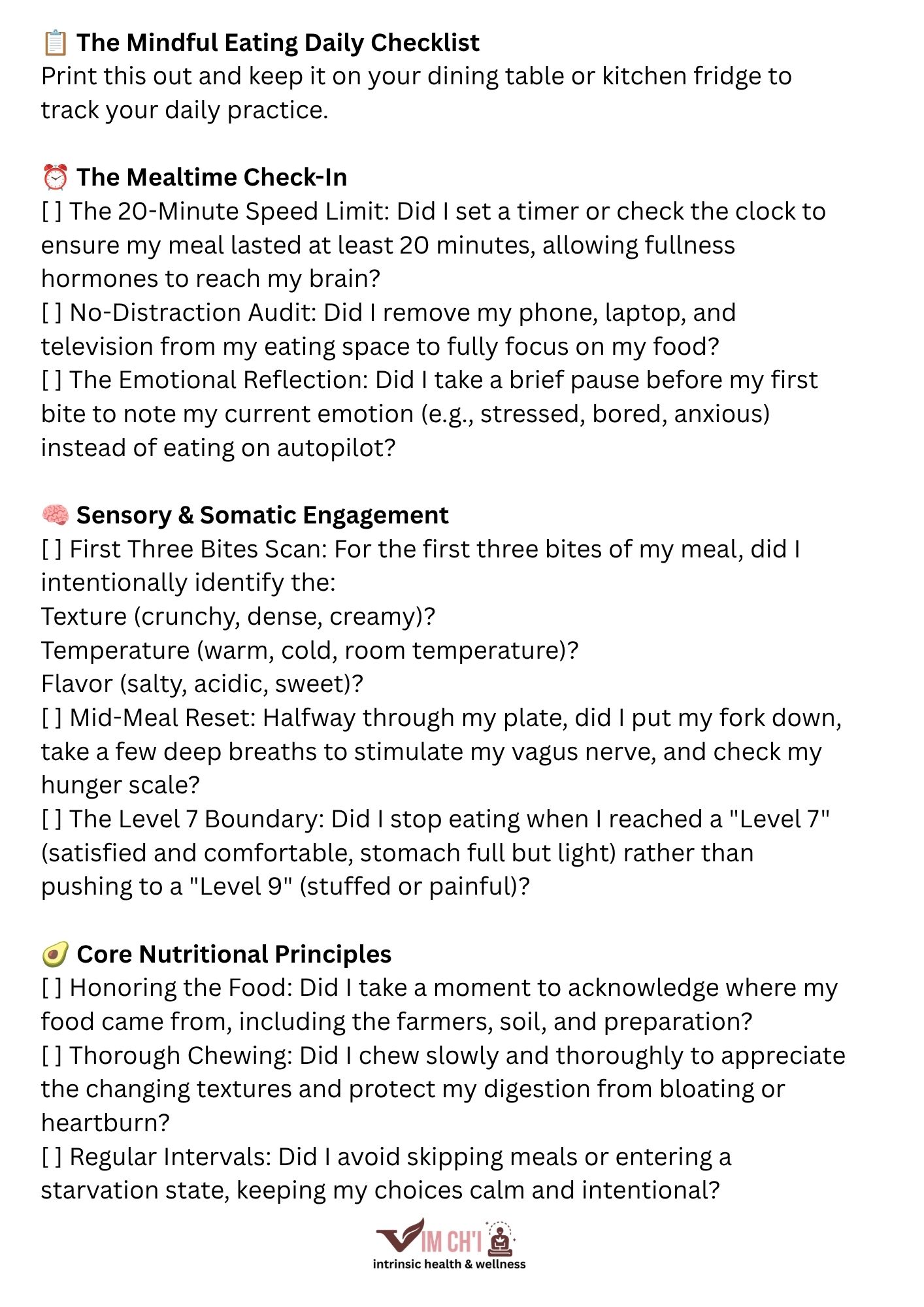
Common Mindful Eating Mistakes
There are common mindful eating mistakes that you must know to avoid falling behind. One of these mistakes is turning mindful eating into a rigid diet. It’s not.
Another mistake is believing that you need to eat each meal slowly. It doesn’t. The goal here is to be more aware of your surroundings when you eat.
You may read the 11 common mindful eating mistakes for beginners if you’re just getting started.

Can Mindful Eating Be Practiced While Fasting?
You can practice mindful eating while fasting. In fact, practicing mindful eating during your eating window is helpful. This practice lets you break your fast slowly so you can stop bloating.
Before you eat your food, pause. It allows your blood sugar to come back up so you can think clearly and make mindful decisions.
If you have been practicing restrictive eating for a while now and you wish to transition, you may read our OMAD to mindful eating guide for a deeper discussion.
How Mindful Eating Can Be Started Today
You can start mindful eating today by learning how to pause before you eat. For your next meal, try these things:
Before eating: Ask yourself how hungry you are and what you’re feeling.
During eating: Put down all distractions for a few minutes so you can pay attention to your food’s taste and satisfaction.
After eating: Ask yourself how you feel physically and emotionally now.
You can repeat this process tomorrow.
Don’t be discouraged if you didn’t do it properly today. Remember that mindful eating develops through repetition, instead of perfection.
Use a Mindful Eating Journal to Put It Into Practice
Using a mindful eating journal can help you greatly if you wish to practice those principles mentioned above. Our mindful eating journal provides a way for you to notice what’s happening before, during, and after eating.
The journal encourages you to explore how you were hungry before eating or what your emotions were. You can also recognize what cravings influenced you or how the food tasted and felt.
The basic process is simple:
First, you have a pre-meal check, then start mindful eating, and reflect after a meal.
Our mindful eating journal includes a craving tracker and weekly reflection pages so you can look for recurring patterns.
You can download the intuitive eating journal here.
On the other hand, if you’re not ready for a full journal, you can start smaller. Our free mindful eating starter kit provides you with a way to practice the techniques we mentioned above.
Get your free mindful eating starter kit here.
Frequently Asked Questions (FAQs)
What is the meaning of mindful eating?
Mindful eating is an approach to food. It focuses on your sensory awareness and experience of the food. It has little to do with calories and macronutrients. You just need to pay attention to your food and the purpose of eating moment by moment without judgment.
What are the 5 Ss of mindful eating?
The 5 S of mindful eating would include sitting down, slowly chewing your food, savoring every bite, simplifying things, and smiling.
Can you lose weight by mindful eating?
Yes. Mindful eating can help you lose weight because it helps you change your habits, instead of restricting your foods. It also promotes weight management as it slows down your eating pace. It also improves your portion control while it teaches you to separate true physical hunger from just your emotional triggers.
What is an example of mindful eating?
Mindful eating means engaging all your senses. It makes you fully present while you eat. One example is to set your utensils down between bites. It’s also vital that you eat without distractions. Thus, avoid TVs. You should also chew thoroughly to identify the flavors in your food. Then, before every bite, pause to check if you’re physically full.
What are the basics of mindful eating?